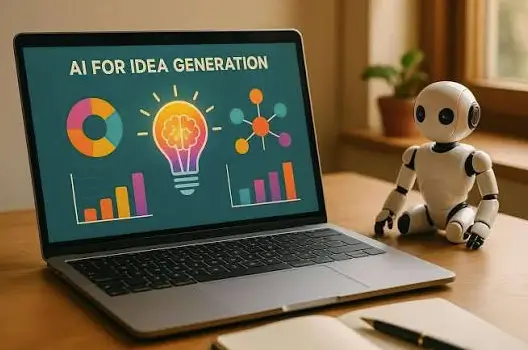
How AI Helps Designers Generate Ideas

AI accelerates idea generation by rapidly synthesizing mood boards, concept sketches, and visual language from diverse inputs. It maps tonalities, palettes, and typography, tests alternatives, and quantifies impact to converge on cohesive styles. In rapid prototyping, AI translates concepts into tangible iterations while considering user context and potential outcomes. The balance of machine insight with human judgment preserves originality and clear ownership, inviting designers to weigh data against intuition as directions solidify.
How AI Accelerates Early Mood Boarding and Concept Sketches
AI accelerates the early stages of design by streamlining mood boards and concept sketches with data-driven tools. In this phase, teams gather diverse inputs, test assumptions, and unify visual direction quickly.
AI supports idea generation and concept iteration through rapid synthesis, objective benchmarking, and collaborative feedback loops, enabling disciplined exploration while preserving individual autonomy and creative freedom.
Using AI for Style Exploration and Visual Language
Style exploration and visual language rely on AI to systematically map and test tonalities, palettes, and typographic sensibilities across multiple scenarios. It enables designers to compare alternatives, quantify impact, and converge on cohesive language with measurable criteria. The approach remains pragmatic and collaborative, prioritizing freedom through data-driven experiments that reveal relationships between style exploration choices and audience perception within diverse contexts.
Rapid Prototyping and Context-Aware Inspiration With AI
Rapid prototyping with AI accelerates the design process by translating ideas into tangible iterations quickly while preserving feasibility checks and user context. Teams leverage rapid prototyping to test concepts, measure impact, and iterate based on data.
Context aware inspiration emerges from real user signals, enabling adaptive briefs and responsive visuals. The approach supports collaborative workflows and freedom to explore without sacrificing rigor.
See also: aboutlines
Balancing Human Judgment With AI Suggestions for Original Ideas
Design teams balance machine-generated suggestions with disciplined human judgment to preserve originality while leveraging AI’s pattern recognition and data insights. In practice, teams fuse human insight with algorithmic variance to explore alternatives, test concepts, and filter results.
Decisions rely on measurable criteria, iterative validation, and clear ownership. The approach fosters freedom within structure, ensuring AI augments creativity without replacing strategic discernment or contextual nuance.
Frequently Asked Questions
How Can AI Respect Brand Ethics in Generated Concepts?
AI respects brand ethics by enforcing transparency standards, tracing inspiration provenance, and aligning outputs with brand integrity; practitioners evaluate data sources, implement guardrails, and measure impact, ensuring collaborative, data-driven processes that satisfy an audience seeking freedom within ethical constraints.
Do AI Tools Replace Human Designers in Ideation?
AI tools do not replace human designers in ideation; they enable AI collaboration that accelerates ideation efficiency, supplying diverse options while humans steer meaning, ethics, and context. Data-driven collaboration supports freedom to choose and refine ideas.
Can AI Reveal the True Source of Inspiration?
AI cannot definitively reveal true inspiration provenance; it analyzes patterns and inputs to suggest origins. It supports ethical originality by tracing data influences, while collaboration and transparent workflows help designers evaluate inspiration sources and maintain freedom in creative exploration.
How Do I Quantify Ai’s Creative Originality?
AI originality is quantified through Creative metrics, parallel metrics, and cross-domain comparisons; AI originality is measured by novelty, usefulness, and reproducibility, with pragmatic, data-driven analysis, collaborative validation, and freedom-minded reporting to inform design decisions and comparisons.
What Are the Best Practices for Integrating AI With Teams?
Best practices emerge from clear governance, cross functional collaboration, and measurable outcomes; AI ethics guides decisions, brand alignment anchors strategies, and dashboards track impact, enabling teams to innovate freely while maintaining accountability and data-driven collaboration across disciplines.
Conclusion
AI accelerates idea generation by rapidly surfacing mood boards, sketches, and visual languages, while data-informed testing guides direction. By blending algorithmic exploration with human critique, teams converge on cohesive styles without stifling originality. The process operates as a well-tuned collaboration: AI proposes, designers filter and refine, and stakeholders validate. Like a compass and map working in tandem, AI and humans navigate the creative landscape—each informing the other to produce inspired, user-centered results.